Each goal can look affordable on its own while the combined plan is too expensive. Check the total commitment, change a flexible target or deadline when needed, and record only money actually set aside.
Choose one contribution budget for the whole plan
Start with the amount you can allocate to these goals after reviewing income, spending, bills and other obligations. This is a contribution limit for a defined period, not your entire income or the current balance of a savings account. The CFPB budgeting guide explains how tracking income, spending and bill dates helps establish what is available.
Match the period across every goal. Compare monthly deposits with a monthly limit, or contributions from one payday with the amount available from that payday. Do not mix a weekly figure for one goal with a monthly figure for another. Check actual payment dates too: a deposit arriving after a bill is due cannot fund that bill on time.
For the original example below, assume $300 is available each month for these three goals. That is an invented planning input, not a recommended savings amount or percentage. All figures use the same currency and exclude interest, fees and withdrawals.
Put every goal in the same worksheet
Write down the target, money already assigned to that goal, and the remaining contribution dates before it is needed. Count dates on which a deposit can actually arrive. In this example, there is one contribution per month, so four contribution dates means four monthly deposits.
Required deposit = (target − allocated savings) ÷ contribution dates remaining
| Goal | Target | Already allocated | Still needed | Monthly dates left | Required per date |
|---|---|---|---|---|---|
| Annual bill | $600 | $200 | $400 | 4 | $100 |
| Trip | $1,200 | $300 | $900 | 6 | $150 |
| Laptop | $900 | $100 | $800 | 4 | $200 |
The three required deposits add up to $450 per month: $100 + $150 + $200. Compared with the $300 limit, the plan has a $150 monthly shortfall. Each individual deposit is below $300, but that does not make all three affordable together.
The starting allocations total $600: $200 for the bill, $300 for the trip and $100 for the laptop. Those amounts must represent distinct money already set aside. They are not three copies of the same account balance. A funded goal needs no additional deposit. If a gap remains but no contribution dates remain, the original schedule cannot meet the deadline. For the single-goal calculation and date-counting details, use the savings contribution worksheet.
Revise the competing deadlines instead of hiding the gap
Decide which amounts or dates are genuinely flexible. Questions worth asking are: Is this an obligation or an optional purchase? What happens if it is delayed? Can its cost change? Is the current target still useful? Your answers determine the priorities; a fixed split such as one-third per goal cannot answer those questions for you.
In this fictional plan, the person chooses to keep the bill and trip schedules and delay the laptop. This is their illustrative choice, not a recommendation that travel should take priority over another need.
| Goal | Remaining gap | Chosen monthly deposit | Contribution dates needed |
|---|---|---|---|
| Annual bill | $400 | $100 | 4 |
| Trip | $900 | $150 | 6 |
| Laptop | $800 | $50 | 16 |
The laptop has an $800 gap. At $50 per month, it needs 16 contribution dates, rather than the original four. The combined deposit is now $100 + $150 + $50 = $300. The lower laptop contribution changes its finish date; it does not preserve the original deadline.
These counts assume each chosen deposit stays unchanged. When a goal finishes, review whether its contribution can be redirected to another goal. That could shorten the laptop timeline. A sum of flat deposits tests that particular schedule, not every possible allocation. Here, however, all $2,100 of the original gaps would be needed by contribution date six, while six $300 deposits provide only $1,800. Without changing the assumptions, even redirecting contributions leaves a $300 gap.
Other possible revisions include reducing an optional target or pausing it with a written review date. Do not count hoped-for income as a solution to the shortfall. If a remaining gap has no affordable future deposit, the worksheet has identified an unresolved plan, not a completed goal.
Track the actual deposits, then review all goals together
Keep the chosen schedule in your planning notes. Update each goal balance only after the money has actually been reserved for it. The example begins with the $600 allocated balance above and has no withdrawals or interest.
| Period | Bill deposit | Trip deposit | Laptop deposit | Total deposited | Combined balance |
|---|---|---|---|---|---|
| Month 1 | $100 | $150 | $50 | $300 | $900 |
| Month 2 | $100 | $100 | $50 | $250 | $1,150 |
After month two, the goal balances are $400 for the bill, $550 for the trip and $200 for the laptop, totaling $1,150. The $50 difference from the planned trip deposit belongs in the review, not in the saved balance. A scheduled $150 trip deposit was only $100 in reality. The unused part of the contribution limit is not saved money; check whether it is still available before allocating it.
There are now two bill contributions, four trip contributions and fourteen laptop contributions left in the revised plan. The trip needs ($1,200 − $550) ÷ 4 = $162.50 per contribution to retain its deadline. Alongside $100 for the bill and $50 for the laptop, the next combined commitment would be $312.50, which exceeds the unchanged $300 limit by $12.50. Review a flexible amount or date again; do not assume automatic catch-up is affordable.
If you reassign existing savings between goals, decrease the old allocation as well as increasing the new one. Reallocation does not create new savings. Our separate-funds guide explains balance reconciliation and the difference between planned expenses and an emergency reserve.
Use Frugal for the record, not the budget decision
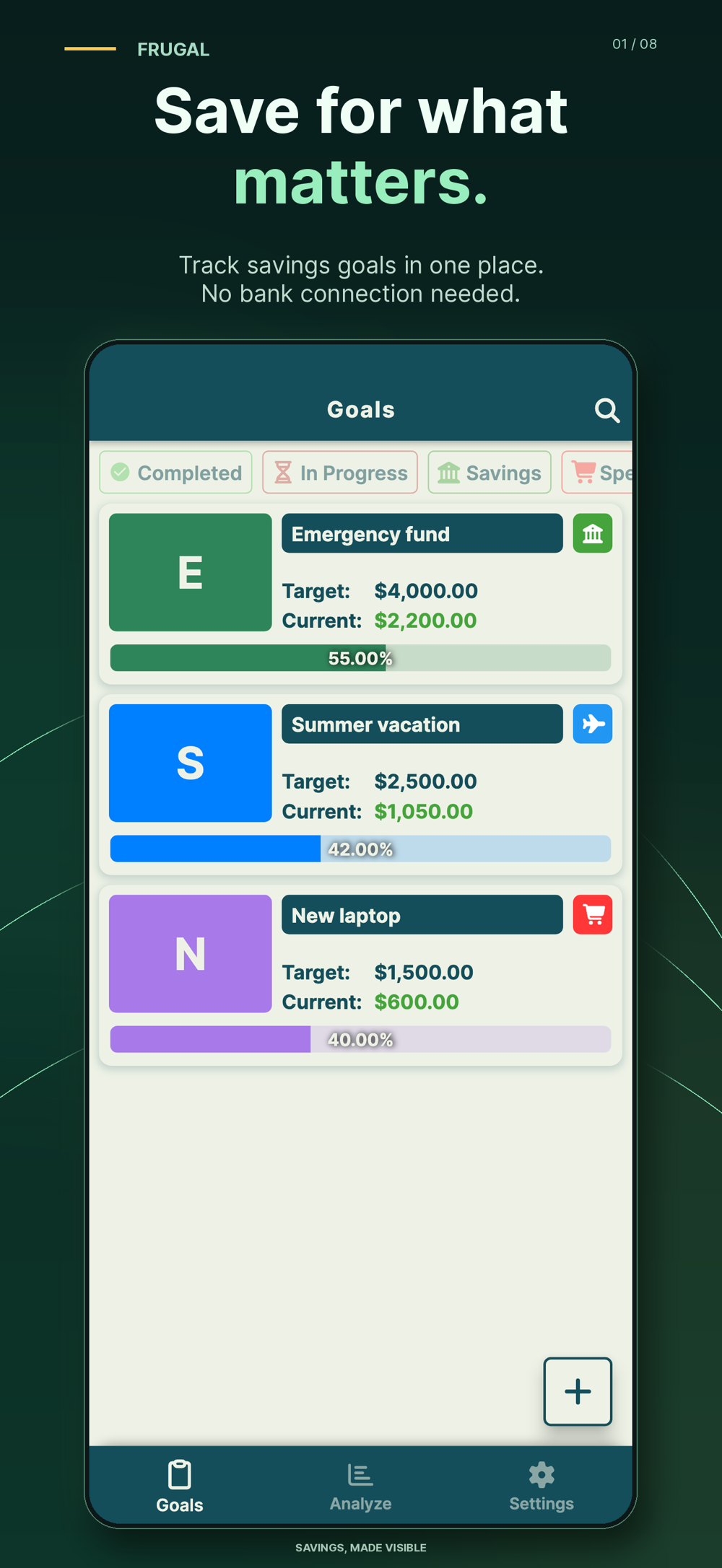
Explore Frugal when you want each target and its actual deposits in one phone-based record. Enter the goal name, target, starting amount and target date. Record real deposits and withdrawals with their dates, then compare the remaining amount with your plan.
The current App Store listing includes reminders and contribution history. Unlimited goals, custom categories, detailed analysis and PDF/Excel exports are Premium features. Check the listing for your platform before relying on a paid feature.
The combined-budget worksheet in this guide is an original website example. It is not an automatic allocation feature, bank integration or app import. The app does not hold or transfer money. Keep the choice of affordable deposits in your own budget review. For another way to maintain the record, compare a savings tracker and spreadsheet.
Reuse a short monthly review checklist
- Write the amount available for new contributions this period.
- List each goal’s target, actual allocated balance and remaining deposit dates.
- Add the required deposits and compare their total with the available amount.
- Write down any revised target, deposit or deadline, including its consequence.
- Record completed deposits once and update withdrawals or reallocation.
- Reconcile the combined allocations with the real money reserved for them.
Keep different currencies in separate totals unless you explicitly convert them using a stated rate and date. A dollar balance and a euro balance cannot be added as if they were the same unit. If income varies, use the irregular-income savings record alongside this combined-goal check.
The CFPB toolkit provides separate savings-plan, goal-revision and cash-flow worksheets. This guide provides general educational record-keeping examples, not personalized financial, investment or tax advice.
Common questions
How do I split savings between several goals?
Calculate what each deadline requires, add those deposits together and compare the total with one affordable contribution budget. If it exceeds the budget, revise flexible amounts or dates. No fixed percentage split fits every set of obligations and priorities.
Should I save for one goal at a time?
That depends on your obligations, deadlines and available money. Several goals can share a feasible budget, while pausing an optional goal may be necessary when the combined plan does not fit. Record the effect on its finish date.
Can I track several goals in one savings account?
You can keep separate allocation records, but their total must not exceed the money genuinely reserved for those goals. Do not enter the full account balance as the starting amount for every goal.
Does Frugal split my paycheck automatically?
No. It records the goal amounts and contributions you enter. The worksheet here is a separate planning example; the app does not allocate your paycheck, hold money or execute transfers.
What happens when a planned deposit is smaller than expected?
Record the actual amount, recalculate the remaining gap and dates for that goal, then check the combined commitment again. A catch-up deposit can make the whole plan exceed the budget even if the individual goal calculation is correct.
References and further reading
Published by Moocsoft, the independent studio behind Frugal. Examples and worksheets are illustrative. App features can vary by platform and version; see the store listing for current availability and in-app purchases.