Contribution per date = (target − current allocated savings) ÷ remaining contribution dates. Use real deposits and real dates when you update the plan.
Write down three inputs
Target: the amount needed for this specific goal. Current savings: money already allocated to it, excluding money promised to another goal. Remaining contribution dates: the paydays or other dates on which you can contribute before the money is needed.
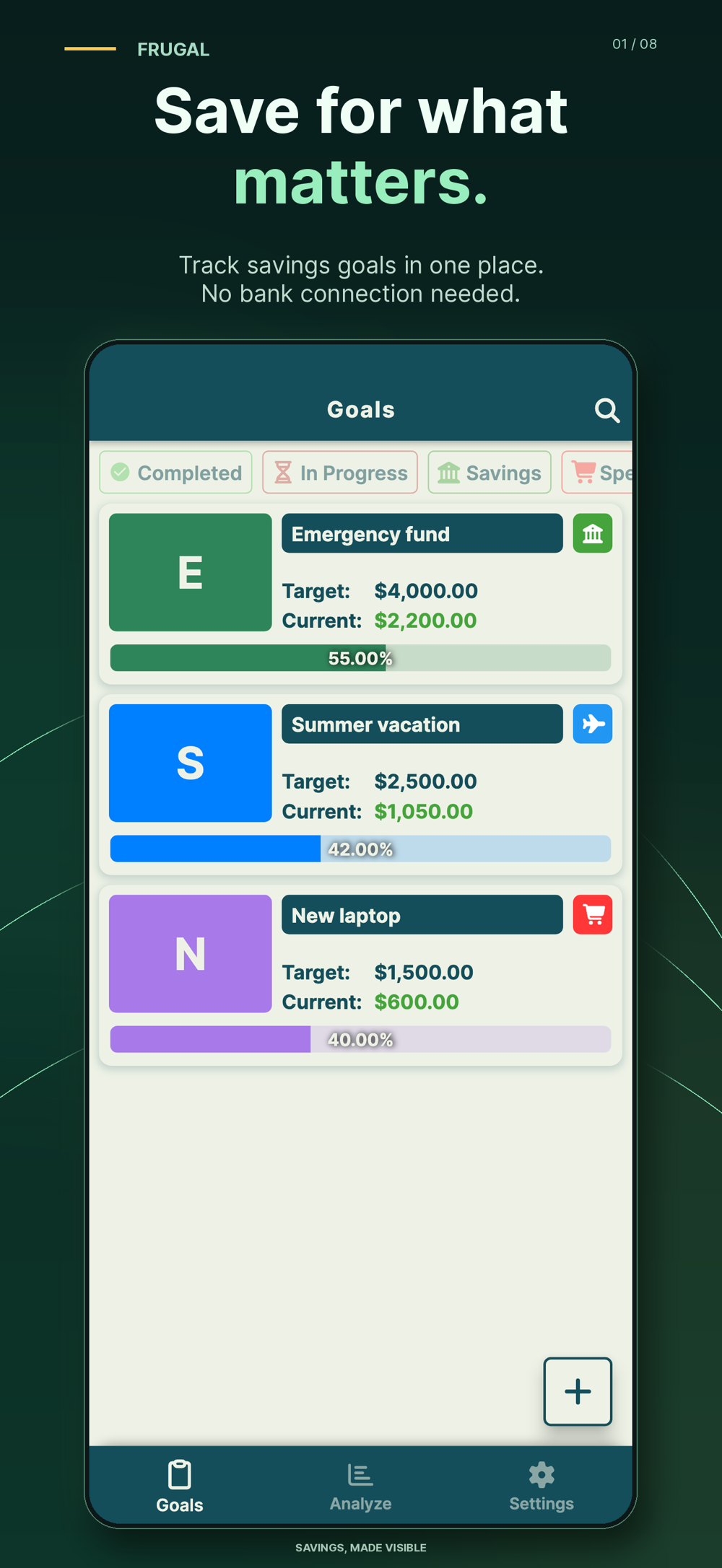
You can keep the target and actual contributions together in Frugal for iPhone and Android. The calculation here tells you what the schedule requires; your spending plan tells you whether you can afford it. If you are choosing where to keep the record, compare a savings app and spreadsheet.
A deadline expressed as “in three months” is not the same as three paydays for everyone. Count the actual dates. If a bill is due before the last payday of the month, that payday cannot help pay it on time.

Make a dated plan before setting a reminder
Suppose a purchase needs $1,200 by November 25. You have $400 allocated, and can contribute on October 5, October 19, November 2 and November 16. That leaves four contribution dates:
($1,200 − $400) ÷ 4 = $200 per contribution
| Contribution date | Planned deposit | Planned balance afterward |
|---|---|---|
| Starting balance | Already saved: $400 | $400 |
| October 5 | $200 | $600 |
| October 19 | $200 | $800 |
| November 2 | $200 | $1,000 |
| November 16 | $200 | $1,200 |
The next payday, November 30, falls after the purchase deadline and is excluded. Notice that four deposits span parts of two months: dividing by two months alone would hide when the money must be available.
To reuse the worksheet, replace the purchase, due date, allocated balance and contribution dates with your own. Write planned deposits in your schedule, then record them as savings only after you have actually set the money aside. For another example of fortnightly timing, see the biweekly savings plan guide.
Calculate the remaining gap
| Target | Already allocated | Dates remaining | Contribution per date |
|---|---|---|---|
| $1,200 | $300 | 9 | $100 |
| $800 | $200 | 12 | $50 |
| $2,000 | $500 | 10 | $150 |
For the first example, $1,200 minus $300 leaves $900, divided across nine dates. If you already have the full target, the additional amount required is zero. If there are no contribution dates left and a gap remains, the original deadline cannot be met through that schedule.
These examples show arithmetic rather than recommended savings amounts. The plan still needs to fit essential expenses and other commitments.
Round carefully when the answer has cents
Suppose the gap is $1,000 with six contribution dates remaining. The division gives approximately $166.6667. Six deposits of $166.66 would total $999.96, leaving four cents. One workable schedule is five deposits of $166.67 followed by $166.65.
For a larger real-world buffer, you might choose a slightly higher target to account for an uncertain expense, but name that buffer separately in your plan. Avoid hiding assumptions in rounded numbers you will no longer understand later.
Recalculate after the unexpected
Return to the $1,200 goal with $300 already saved and nine dates left. After two planned $100 deposits, the allocated balance is $500 and seven dates remain. If the next contribution is missed, the balance stays $500 and six dates remain. The new gap is $700, or about $116.67 per remaining date.
An extra $100 contribution would reduce that gap instead. Recalculate from the current actual balance; do not add the original plan’s future deposits to money already saved.
When a higher required amount is not affordable, your available choices include a later deadline, a smaller target or a revised spending plan. A contribution formula shows the tradeoff; it does not choose it for you.
Check cash flow before treating a reminder as progress
The CFPB guide to cash flow and consistent savings explains that the timing of income and expenses matters, not just their totals. A contribution date can arrive before income clears or alongside a large essential bill.
| When | Check | Record-keeping action |
|---|---|---|
| Before the planned date | Money available after essential expenses and other allocations | Leave planned money in your schedule, not the saved balance |
| After money is actually set aside | Amount reserved for this specific goal | Record the actual contribution once |
| If the contribution is missed or changed | Actual goal balance and remaining dates | Update your planning note; do not record money not saved |
Frugal is a record keeper, not bank automation. Its reminder does not move money or establish that a contribution happened. Keep any bank activity and the app entry separate, then reconcile the recorded balance with money genuinely reserved for the goal. The checklist organizes your record; it does not choose a suitable savings amount for you.
Keep the tracker aligned with money you have saved
In Frugal, give the goal a concrete name and enter its target, starting amount and target date. Record deposits as they happen and withdrawals when you use money from the goal. A reminder can prompt a review, but it does not make a bank transfer.
At each review, compare the app balance with money actually reserved for this goal, subtract that balance from the target, and count the contribution dates still available. Keep the recalculated amount in your planning note. Premium includes PDF and Excel exports if you want a separate copy of your records; check the store listing for current availability.
If you prefer a challenge with increasing contributions and no fixed purchase date, try the free 52-week savings calculator. If you have several targets, read the guide to separate savings funds before assigning the same account balance across them.
Common questions
Should I count expected bonuses as current savings?
No. Keep expected money in the plan and add it to the saved balance only when you receive and allocate it.
What if I miss a deposit?
Subtract the actual current balance from the target and divide by the remaining contribution dates. Then decide whether the new amount or the deadline needs adjustment.
How do I calculate a monthly savings amount?
Subtract current allocated savings from the target and divide by the monthly contribution dates before the deadline. Count actual dates rather than assuming every calendar month contains a usable deposit date.
References and further reading
Published by Moocsoft, the independent studio behind Frugal. Examples and worksheets are illustrative. App features can vary by platform and version; see the store listing for current availability and in-app purchases.