The $5,050 total comes from 100 completed deposits, not a promised result. Choose an affordable multiplier and schedule first, then mark each number only after you have actually saved its amount.

How the 100 envelope challenge works
Write the numbers 1 through 100 on envelopes or in a checklist. Number 1 represents $1, number 37 represents $37, and number 100 represents $100. When you set aside that amount, mark the matching number complete. Use each number once.
1 + 2 + … + 100 = 100 × 101 ÷ 2 = $5,050
You can check the sum by pairing opposite ends: $1 + $100, $2 + $99, and so on. Each pair is $101, and 50 pairs make $5,050. This is money you contribute, not interest, an investment return or extra income created by the challenge.
Why “save $5,050 in 100 days” can be misleading
One completed envelope a day finishes the checklist in 100 days, but that schedule requires $5,050 of available money over the period. The smallest contribution is $1, the largest is $100, and the average across all 100 is $50.50.
Drawing numbers randomly changes the order, not the cost. You could draw $98, $99 and $100 close together: $297 across three deposits. Compare the largest possible deposits with money left after essential expenses, not just the inviting $1 opening amount.
There is no requirement to use consecutive days. A challenge that fits your cash flow is more useful than a deadline you can meet only by borrowing or leaving bills unpaid.
Print the numbered 1–100 checklist
Open the free 100 envelope checklist for the complete 1–100 grid, then use your browser’s Print command to print it or save a PDF. Each numbered space represents one contribution: in the classic version, number 37 means $37. Fill or tick that space only after you have set the money aside.
For a spreadsheet copy, download the numbered 100 envelope CSV. Use each number once, record the date of the actual deposit and add the completed amounts to check your total. A plan row is not proof that the deposit happened.
The checklist and CSV are free website worksheets. They do not connect to a bank or import your checklist into Frugal. The app’s Premium PDF/Excel exports are separate features for your app records.
100 envelope challenge chart: every ten numbers
| Envelope numbers | Group deposit total | Cumulative total |
|---|---|---|
| 1–10 | $55 | $55 |
| 11–20 | $155 | $210 |
| 21–30 | $255 | $465 |
| 31–40 | $355 | $820 |
| 41–50 | $455 | $1,275 |
| 51–60 | $555 | $1,830 |
| 61–70 | $655 | $2,485 |
| 71–80 | $755 | $3,240 |
| 81–90 | $855 | $4,095 |
| 91–100 | $955 | $5,050 |
The cumulative column assumes groups are completed in numerical order. Otherwise, add the amounts actually completed. Ten filled envelopes do not automatically mean $55; that total applies specifically to numbers 1 through 10. Use the numbered 1–100 checklist to mark individual contributions.
Use a smaller-budget version before starting
Multiply every envelope number by the same amount to resize the challenge. With a $0.10 multiplier, number 37 means $3.70. With $0.50, it means $18.50. The checklist still has 100 numbers; only the contribution amounts change.
| Multiplier | Number 1 | Number 100 | Full total |
|---|---|---|---|
| $0.10 | $0.10 | $10 | $505 |
| $0.50 | $0.50 | $50 | $2,525 |
| $1 | $1 | $100 | $5,050 |
If uneven amounts are the problem, replace the numbered rule with a flat plan. One hundred $5 deposits total $500; $10 every week for 52 weeks totals $520. Those are different plans, not completed $5,050 challenges. For another gradual option, compare the 52-week savings challenge chart.
Build the schedule around your paydays
Before drawing a number, list your next pay dates, bills and affordable contribution amounts. Choose numbers that fit that plan rather than treating a random draw as a payment you owe.
For predictable classic deposits, completing one opposite-number pair per week means $101 each week for 50 weeks. That is still a substantial commitment. A $0.10 version needs $10.10 weekly and totals $505 after 50 completed pairs. For every-other-payday contributions, use the biweekly planning guide to count usable dates.
The CFPB’s Your Money, Your Goals toolkit provides separate tools for savings planning, income tracking and cash-flow budgeting. Use those jobs together: a challenge organizes deposits; it does not show that the next one is affordable. For a dated purchase, calculate the required amount with the savings contribution worksheet instead.
Keep the checklist and the saved balance honest
Suppose you complete numbers 4, 20 and 37 in the classic version. Your contribution total is $61 and three numbers are complete. Saving another $10 without assigning it to a number makes the real balance $71, but does not complete an additional numbered envelope.
Keep that extra amount clearly labeled until you decide how it belongs in the plan. If you withdraw money, reduce the available balance and note what happened. A colored checklist alone cannot show whether the money remains reserved.
You do not need physical envelopes: a personal note can hold the number checklist while an account or another suitable place holds the money. Choose storage based on security and access needs, not the photo appeal of cash-filled envelopes.
Turn the challenge into a goal you can update on your phone
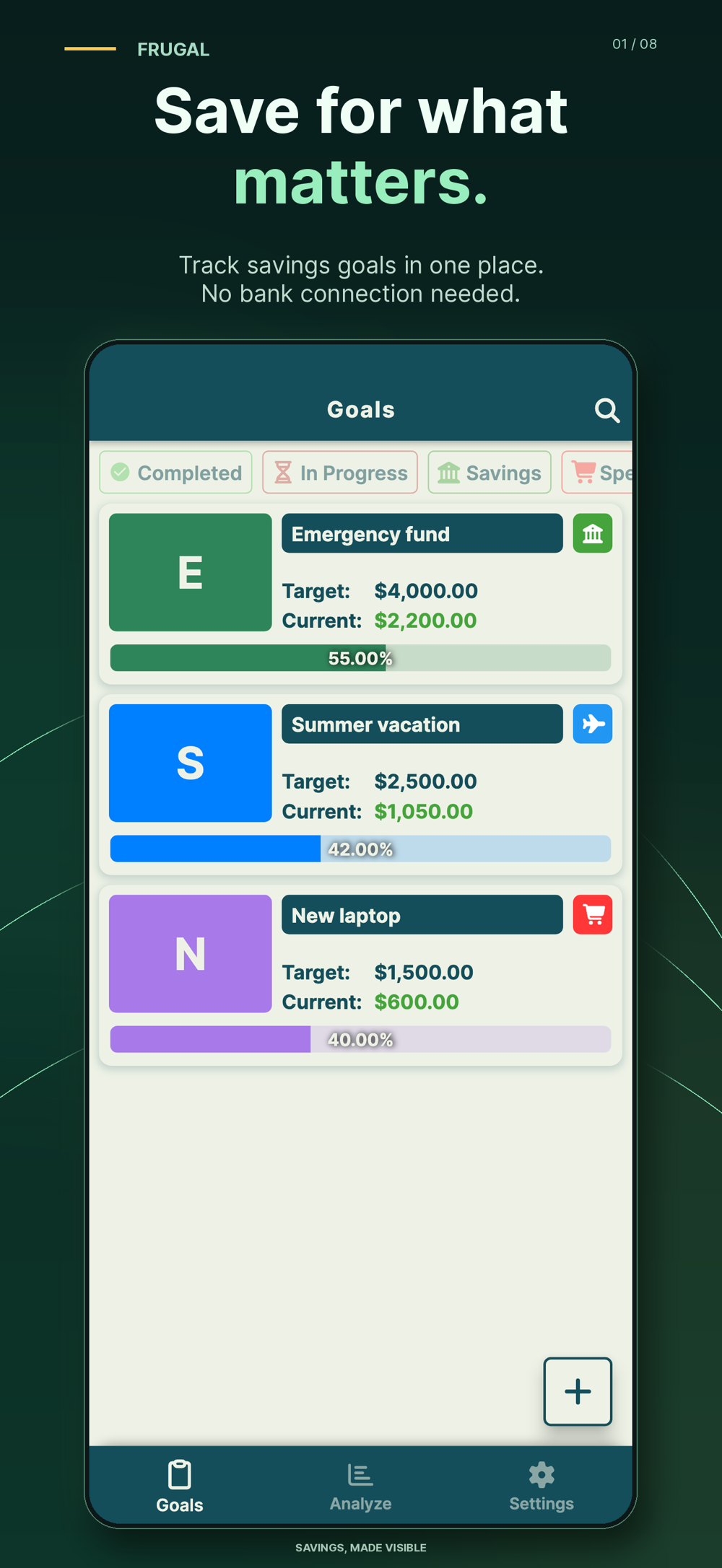
In Frugal, create one goal named for the purpose, such as “Travel fund — 100 envelope plan.” Enter your chosen target, starting amount and realistic target date. Record each real contribution with its date and amount; keep the separate numbered checklist on your printout or in your personal spreadsheet.
The app records goals, contributions and progress. It does not automatically run this 100-envelope method, connect to your bank or move money. It is free to download, with optional Premium for unlimited goals and PDF/Excel exports. Begin with an affordable version and one accurate record, not 100 separate app goals.
Common questions
How much money does the 100 envelope challenge save?
The classic $1-to-$100 version totals $5,050 if every numbered contribution is completed once. A $0.10 multiplier totals $505; a $0.50 multiplier totals $2,525. These totals exclude interest, fees and withdrawals.
Do I have to finish the challenge in 100 days?
No. One contribution daily takes 100 days, but you can use a longer schedule that fits your income and expenses. The total depends on completed contributions, not the speed of completion.
Can I do the 100 envelope challenge without cash?
Yes. Keep a numbered checklist and set the money aside in a place appropriate for you. Record actual deposits in a savings tracker, then reconcile that record with the money reserved for the goal.
Is the 100 envelope checklist free to print?
Yes. The website’s full 1–100 checklist and CSV are free, with no app or Premium required. Open the printable checklist and use your browser’s Print command to print it or save a PDF. App Premium exports are separate.
References and further reading
Published by Moocsoft, the independent studio behind Frugal. Examples and worksheets are illustrative. App features can vary by platform and version; see the store listing for current availability and in-app purchases.