Review available money before each contribution, record actual deposits rather than expected income, and recalculate the remaining goal after a lean or unusually strong period. A tracker organizes the record; it does not decide an affordable amount or move money.
Start with received money, not an average paycheck
A monthly average can help describe past earnings, but it is not the money available today. An unpaid invoice, expected extra shift or promised payment belongs in your planning notes until the money arrives. Do not add it to the saved balance.
Keep a separate list of payment dates and upcoming commitments. The CFPB toolkit includes income tracking and cash-flow worksheets for comparing what comes in with what must go out. A goal tracker complements that picture; it is not a replacement for it.

Check the next commitments before selecting a deposit
Before allocating money to this goal, review essential spending, bills due before the next payment, and amounts already reserved for other purposes. Include any applicable obligations, such as taxes, using information appropriate to your situation rather than a percentage invented by a savings app.
For a simple planning check, subtract those commitments from received income. A positive remainder is a candidate for review, not an instruction to save it all. Check the timing too: a bill due tomorrow cannot wait for income expected next week. The CFPB explanation of cash flow and fluctuating income discusses why these dates matter.
Work through four fictional months
Imagine a $1,000 goal with $200 already set aside. The figures below are invented, exclude interest and withdrawals, and are not recommended income, spending or savings amounts. “Commitments” includes the expenses and other reserved amounts in this example; the remainder is not automatically saved.
| Month | Income received | Commitments | Remainder | Actually set aside | Goal balance |
|---|---|---|---|---|---|
| 1 | $1,200 | $1,100 | $100 | $60 | $260 |
| 2 | $1,800 | $1,200 | $600 | $250 | $510 |
| 3 | $1,000 | $1,050 | −$50 shortfall | $0 | $510 |
| 4 | $1,600 | $1,200 | $400 | $180 | $690 |
The actual deposits total $490: $60 + $250 + $0 + $180. Added to the starting $200, the recorded balance becomes $690, leaving $310 to the target. The unused positive remainders are not counted toward this goal unless they are genuinely allocated to it.
Month three has a $50 shortfall. Recording a zero contribution does not solve that shortfall; it simply keeps the savings record honest while the person reviews their cash flow. A larger deposit in month two does not prove that the same amount will be affordable again.
Treat a lean week as a review, not a fictional deposit
If you cannot afford the next planned contribution, leave the actual saved balance unchanged. Keep the missed amount in a planning note, not the contribution history. Review your target and timing instead of assuming you must catch up by doubling the next deposit.
In the example, $310 remains. Four future contributions would require an average of $77.50 each, but that arithmetic does not establish affordability. Fewer contributions, a revised target or a later deadline may require another review. Use the contribution calculation guide to check the numbers without treating them as a budget recommendation.
Record variable deposits in Frugal
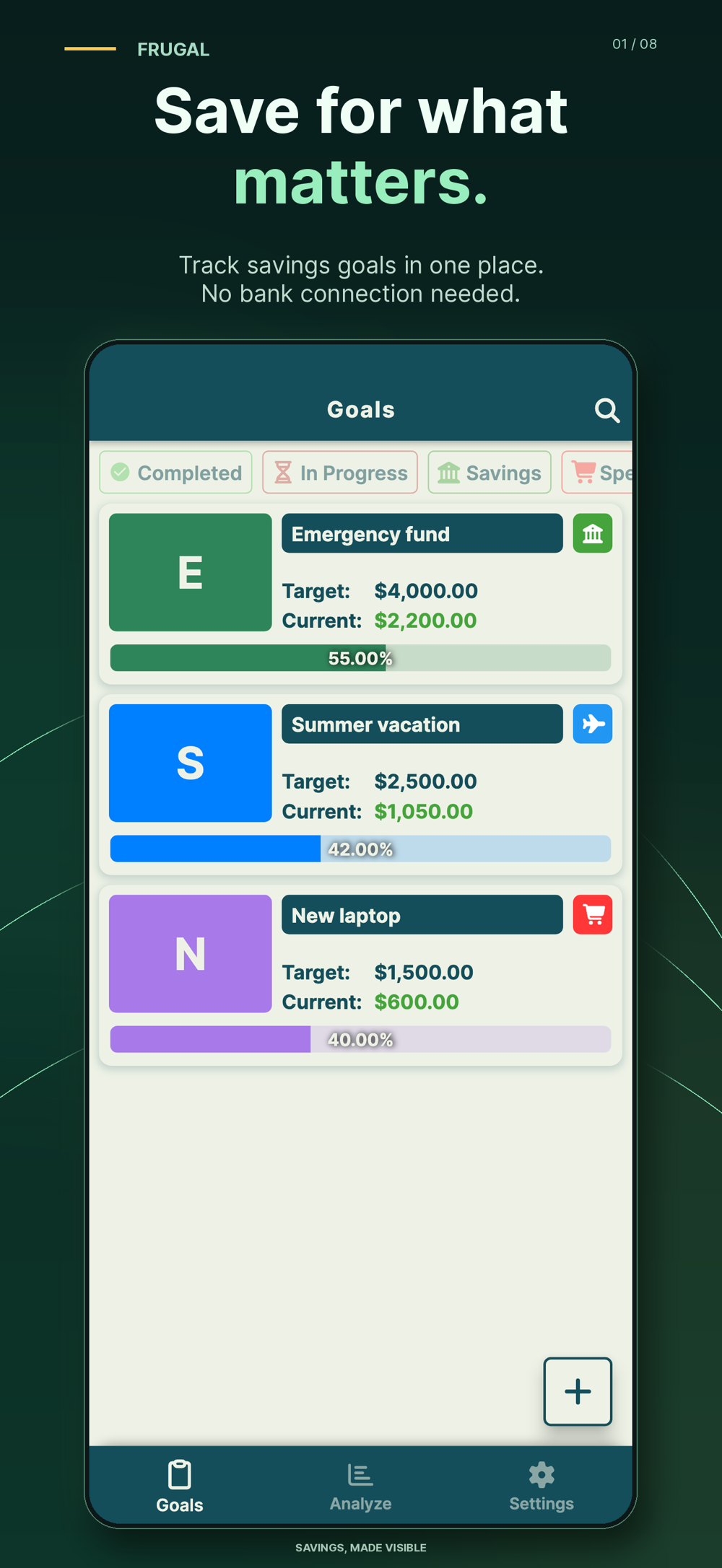
Frugal for iPhone and Android lets you set a target and record deposits and withdrawals with dates and amounts. Enter the real starting balance once, then add each contribution after you have actually reserved the money. If you use money from the goal, record the reduction too.
The app does not connect to your bank or make a transfer. A reminder prompts a review; it is not proof that money moved. Compare the recorded total with money genuinely allocated to this goal, especially when one account supports several purposes. The separate-funds guide explains how to avoid counting the same money twice.
The app is free to download with optional in-app purchases. Unlimited goals and PDF/Excel exports require Premium; check the current store listing before choosing paid features.
Use a repeatable check instead of a rigid challenge
- Confirm which payments have arrived.
- Review commitments and when they are due.
- Choose an amount that fits the current situation.
- Reserve the money, then record the actual deposit once.
- Update the remaining gap and review the next date.
A 52-week chart can illustrate a schedule, but it should not force increasing deposits when income falls. For an irregular-income routine, make the check repeatable while leaving the amount flexible. This guide is an educational record-keeping example, not personalized financial, investment or tax advice.
Common questions
Should I save the same percentage of every payment?
There is no percentage that fits every situation. Check received income, essential commitments, timing and other allocations before deciding what is affordable. This guide does not recommend a percentage.
Does a missed contribution reset my savings?
No. A missed planned contribution leaves the actual saved balance unchanged. Record a reduction only when money is genuinely withdrawn or reallocated from the goal.
Can Frugal move money automatically?
No. It is a personal record-keeping app, not a bank-transfer service. Record deposits only after money has actually been set aside.
Can I still use a weekly savings challenge?
You can use a chart to understand a possible schedule, but check each deposit against your cash flow. A flexible record of actual deposits may fit changing income better than a fixed increasing amount.
References and further reading
Published by Moocsoft, the independent studio behind Frugal. Examples and worksheets are illustrative. App features can vary by platform and version; see the store listing for current availability and in-app purchases.