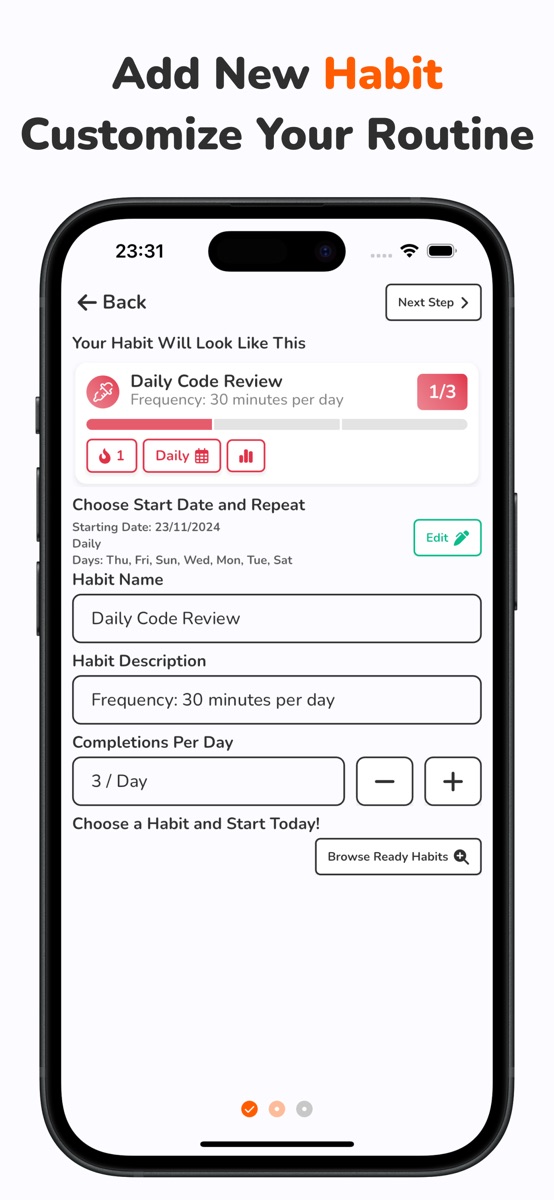
Define the action and schedule, mark only planned completions, calculate completed ÷ planned days and use the review to adjust the next month.
Choose a definition of done
“Study” is difficult to mark consistently. “Review ten flashcards” or “complete one lesson” gives you a boundary. Write the definition beside the calendar so the rule does not quietly change halfway through the month.
If partial progress matters, keep it as a note rather than calling it a full completion under a different standard.
Mark the planned days first
A habit scheduled three times per week should not show four automatic failures on the other days. Mark or list the intended dates before tracking begins.
For a daily action, every date may be planned. For weekdays, weekends are neutral unless you deliberately add them.
If work dates change each week, use the shift-work habit worksheet to choose eligible opportunities and handle check-ins after midnight.
Calculate the monthly completion rate
| Item | Count |
|---|---|
| Planned days | 20 |
| Completed planned days | 16 |
| Missed planned days | 4 |
| Completion rate | 16 ÷ 20 = 80% |
Do not divide by every calendar day unless the habit was planned every day. A completion rate describes adherence to your own schedule, not the importance of the habit.
Look for patterns without inventing a story
Check whether missed days cluster around travel, late meetings or an unrealistic time slot. Record what you know, and avoid assuming a cause from one month of marks.
A note such as “three misses followed late shifts” is more useful than “I have no discipline.” It points to a schedule you can test next month.
Compare weekdays with weekends or morning plans with evening plans only when the schedule gives both groups enough examples. One unusual week may not justify rebuilding the whole habit.
Set up the next month in Habit Tracker Daily
Keep the same rule if it still fits, or change one part deliberately: the action size, repeat days or cue. Habit Tracker Daily supports flexible schedules, calendar check-ins and progress charts so the plan and review stay together.
Write the change in plain language—for example, “five pages instead of ten” or “Tuesday and Saturday instead of daily.” That makes the next review a comparison of two known plans.
Preserve the previous month rather than rewriting missed days. An honest history shows whether the revised plan works better.
Common questions
Should unplanned days lower my completion rate?
No. Divide completed planned days by total planned days. Neutral rest days are not missed completions.
Should I reset my tracker every month?
Start a new calendar period, but keep the earlier record. The history helps you compare schedules and identify repeatable patterns.
Published by Moocsoft, the independent studio behind Habit Tracker Daily. Examples and worksheets are illustrative. App features can vary by platform and version; see the store listing for current availability and in-app purchases.