Use streaks for continuity and a completion rate for the wider period. Always check the date range and what counts as an opportunity before comparing numbers.
Define the three measures
Current streak counts consecutive completed opportunities near the present. Longest streak is the largest uninterrupted run in the record. Completion rate is completed opportunities divided by eligible opportunities in a chosen period.
A tracker must decide how to handle today before it ends, planned rest days and edits to earlier dates. Check those rules before comparing one app’s number with another. A difference can come from the definition rather than an incorrect calculation.
Read one 14-day example
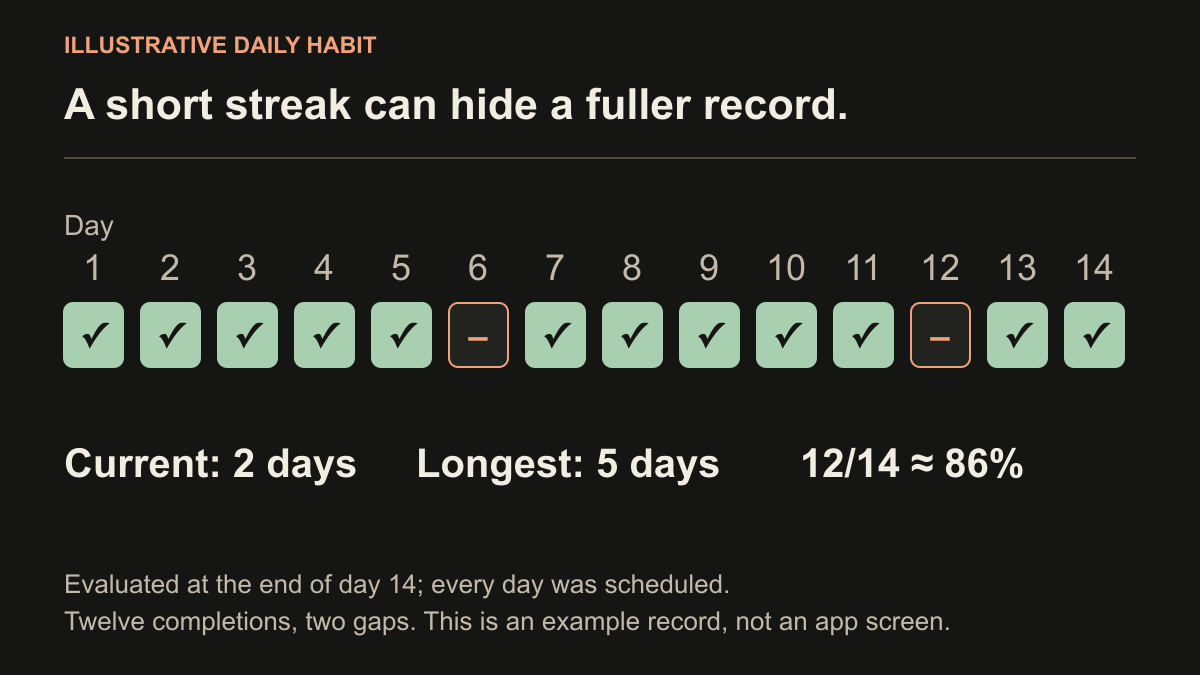
Imagine a daily habit with this record: complete days 1–5, miss day 6, complete days 7–11, miss day 12, then complete days 13–14. There are twelve completed days out of fourteen.
| Metric | Calculation | Result |
|---|---|---|
| Current streak at the end of day 14 | Days 13 and 14 | 2 days |
| Longest streak | Days 1–5 or days 7–11 | 5 days |
| 14-day completion rate | 12 ÷ 14 × 100 | About 86% |
The two-day current streak does not mean only two days of effort occurred. The 86% rate does not mean the habit was uninterrupted. Each number describes a different feature of the record.
Choose the denominator that matches the plan
For a daily habit, each calendar day in the measured period can be an opportunity. For a habit scheduled three times a week, the denominator should be those scheduled occasions if you want a schedule-based rate.
Suppose you planned three sessions and completed two. The rate for that plan is 2 ÷ 3, or about 67%. Dividing by seven would measure the share of calendar days instead. Keep the label clear, especially when comparing routines with different schedules.
Do not include future opportunities in a “so far” rate unless the interface explicitly describes a full-period target. Today’s partial progress and a completed month are not the same kind of period.
Understand the free calendar’s rules
The Moocsoft daily calendar anchors the current streak on today if it is marked, or on yesterday if today is not yet marked. This allows the current day to remain open. If neither day is completed, the current streak is zero.
Its longest streak uses all stored completed dates. The displayed monthly completion rate uses calendar days elapsed through today for the current month, all days for a past month, and no eligible days for a future month. It does not adjust for selected weekdays.
Entries stay in that browser’s local storage. Use the same browser and avoid clearing its site data if you want to keep the record; it is not an account-based backup.
Use the metric to ask a useful question
A shorter current streak can prompt you to look at what interrupted the routine. A steady monthly rate can show a pattern that a recent reset hides. Neither number explains the reason on its own.
Choose the next action based on context: adjust a schedule that repeatedly conflicts with work, clarify an ambiguous completion rule or make the check-in easier to remember.
Habit Tracker Daily brings calendars, flexible schedules and progress charts together. Use its displays with the same care about definitions and time windows, and export a copy when you want to retain your data outside the device.
Common questions
Which number is better, a streak or a completion rate?
They answer different questions. A streak describes an uninterrupted run, while a completion rate summarizes a chosen period. Use the one that fits the question you are asking.
Why can my current streak be shorter than my longest streak?
The longest streak records the best uninterrupted run in the history. The current streak describes the run continuing near the present.
Published by Moocsoft, the independent studio behind Habit Tracker Daily. Examples and worksheets are illustrative. App features can vary by platform and version; see the store listing for current availability and in-app purchases.