Oil calorie estimate = measured oil grams ÷ label serving grams × label calories. Distribute that input across portions only when the oil was transferred, retained and reasonably evenly shared. Keep unknown leftovers or absorption labeled as unknown.
Match the measured amount to the label
Start with your product’s actual label, not a generic spoonful. The FDA serving-size explanation distinguishes a household measure from its stated gram amount and explains that nutrition figures usually describe one labeled serving. That serving is not a recommendation about how much oil to use.
If you measure in grams, use the label’s gram quantity. Do not put a milliliter amount into a grams-based calculation as though the units were identical. A volume measure needs a matching volume reference or a suitable product-specific conversion; the calculation below uses grams throughout.
A tared container can measure oil placed in it. Alternatively, weigh the same bottle before and after dispensing, on a stable surface with the same cap or dispenser attached and the outside clean. Check the scale’s units and limits. That difference records what left the bottle, within the measurement’s precision—not automatically what entered the food. Oil left in a measuring cup or spilled during pouring still matters.
Measure ingredients safely on a suitable work surface before cooking; do not place hot cookware on an ordinary kitchen scale. Record enough context to repeat the method without treating a household measurement as laboratory precision.
Calculate the measured oil input first
These are invented worksheet figures, not nutrition values for a named product, recommended quantities or NutriLens scan results. The hypothetical label says 120 kcal per 14 g.
| Record | Example value | Meaning |
|---|---|---|
| Bottle before dispensing | 842 g | Same bottle and cap/dispenser configuration |
| Bottle after dispensing | 814 g | No unrelated use between measurements |
| Difference | 28 g | Oil removed from the bottle, not measured oil eaten |
| Hypothetical label | 120 kcal per 14 g | Use the real label for your own product |
| Calculated input | 240 kcal | The label-based amount for those 28 g |
842 − 814 = 28 g removed
28 ÷ 14 × 120 = 240 kcal for that measured input
The subtraction and label scaling answer a limited question. If oil drips elsewhere or remains in a measuring container, 28 g is not proof that all 28 g entered the pan. Even when all of it entered the pan, that alone does not prove all of it was served and eaten.
Keep the source and assumption in the note: “28 g dispensed; example label 120 kcal/14 g; transfer and retention still to check.” Do not replace a missing observation with an invented absorption percentage.
Allocate to a portion only under stated assumptions
For this next calculation only, assume all 28 g reached and remained in an 800 g finished dish, and the oil was distributed reasonably evenly. The finished batch weight includes its ingredients; exclude the container. This is a declared recipe-accounting assumption, not evidence that real cooking always retains all oil.
| Serving from the batch | Share of 800 g dish | Oil contribution under the assumptions |
|---|---|---|
| 200 g | 200 ÷ 800 | 240 × (200 ÷ 800) = 60 kcal |
| 300 g | 300 ÷ 800 | 240 × (300 ÷ 800) = 90 kcal |
A 200 g serving is one quarter of the batch, so its added-oil estimate is 60 kcal. A 300 g serving is three eighths, so the corresponding estimate is 90 kcal. These are alternative serving sizes. They describe only the oil component, not the meal’s total calories.
Four genuinely equal, representative servings would each contain one quarter of the recipe’s oil allocation. Weighing equal portions does not establish even distribution if oil or sauce is concentrated in one part. When components are served separately, record them separately rather than pretending every gram of the dish is identical.
For the complete meal, add the other ingredient estimates once and apply an appropriate portion method. The homemade-meal worksheet covers that full recipe calculation.
Keep pan leftovers and absorption uncertainty visible
If an unknown amount stays in the pan, is drained away or remains on utensils, the fully retained example no longer establishes the oil eaten. There is no absorption rate measured by this worksheet.
Do not weigh mixed pan residue and subtract that whole weight as pure oil. Residue can include water, sauce and food as well as oil. Without knowing what it contains, its total mass does not identify the oil component. A photo of the finished dish does not supply the missing measurement either.
| What you know | Useful record | Do not conclude |
|---|---|---|
| Oil weighed before adding | Measured input and matching label basis | Every gram was necessarily eaten |
| All oil transferred into an evenly mixed, fully retained batch—an explicit assumption | Conditional allocation to the portion eaten | The same assumption applies to every recipe |
| Some mixed residue remains, amount of oil unknown | Input known; retained/eaten oil uncertain | Residue mass equals oil mass, or an exact percentage was absorbed |
| Only a meal photo, no recipe or quantity | Photo estimate with unknown cooking oil noted | A measured oil amount or zero oil |
A practical note can say “input measured; some pan residue; amount eaten uncertain.” If you choose to keep an all-input recipe estimate, label that assumption rather than calling it measured absorption. This article does not prescribe a universal logging rule for frying, draining or restaurant meals.
For a packaged product, check the serving-versus-container label guide. For a scan, use the photo-estimate comparison checklist without assigning an exact error percentage to an unknown recipe.
Count recipe oil and plate-only oil once each
Under the fully retained batch assumptions above, the 200 g portion already includes a 60 kcal share of recipe oil. Suppose a separately measured 3.5 g of oil is then added only to that plate. For this example, assume the extra oil reaches the plate and both the described portion and addition are fully eaten. With the same invented label, 3.5 ÷ 14 × 120 = 30 kcal.
| Entry | Correct scope | Example oil estimate |
|---|---|---|
| Recipe oil already allocated to 200 g serving | One quarter of the batch oil | 60 kcal |
| Separate 3.5 g addition to that plate | Only the new plate addition | 30 kcal |
| Combined oil component | 60 + 30, counted once each | 90 kcal |
| Incorrect: adding all 240 kcal of batch oil again | Counts oil belonging to the whole dish on one plate | Not an additional portion entry |
If your full recipe estimate already includes oil, do not add the recipe’s oil allocation again after calculating the serving. The separate plate addition belongs only to the plate that received it, not every portion of the batch.
Use the same scope check with a meal scan. First review what the estimate appears to include. Do not automatically add all the measured oil on top of a photo estimate of the same prepared dish. If the overlap cannot be resolved, keep the comparison and uncertainty in separate notes rather than manufacturing an exact combined total.
Use a short oil-and-meal note, not a precision promise
Copy these fields for one familiar meal: product/label basis; oil measured; measurement method; transfer or residue uncertainty; whole-batch versus plate-only addition; portion share; and whether the oil is already included in the recipe estimate. Keep the fields outside the app when needed.
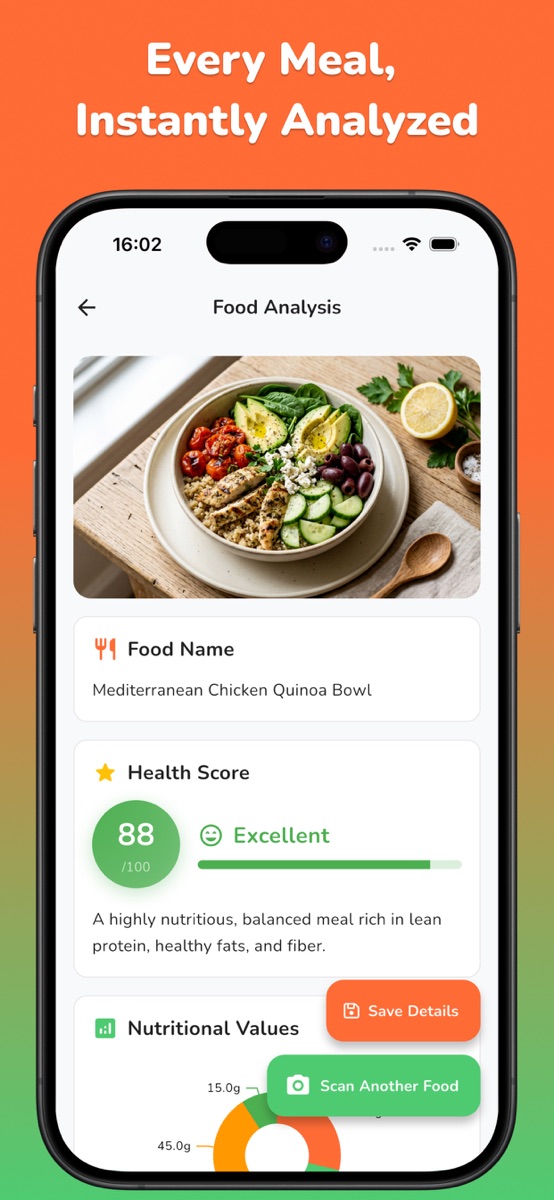
Try NutriLens for the photo-first part of the record: take a meal photo or select one from your gallery, then review the estimated calories and macros. The weighed-oil worksheet is separate. It is not an oil-weighing, absorption-measurement, manual-correction or label-import feature in NutriLens.
The current official listings describe optional paid access. NutriLens is free to download with subscriptions and scan credit packs; detailed analysis and saving or revisiting scans are listed as Premium features on iOS. Check the store for your platform and version rather than assuming unlimited free use.
This is general food record-keeping, not a meal prescription or individualized medical nutrition advice. A scan cannot verify allergy safety. If detailed tracking becomes distressing, it is reasonable to pause; no oil calculation needs to become a test you must pass.
Common questions
How do I calculate cooking oil calories from grams?
Divide the measured oil grams by the label serving grams, then multiply by the calories for that labeled serving. The result describes that measured amount; allocating it to food eaten requires separate transfer, retention and portion assumptions.
Does a bottle-weight difference show the oil I ate?
No. It measures what left the bottle within the scale’s precision. Spills, oil left in another container, pan residue and the portion eaten can change what reached your plate.
Can I subtract the weight of leftover pan liquid as oil?
Not as though it were pure oil. Mixed residue may contain water and food. Its total weight does not establish the oil it contains. Keep an unknown retained amount labeled as uncertain.
Should I add cooking oil to a photo calorie estimate?
First check whether the estimate already covers the prepared dish and its oil. Do not count the same ingredient twice. Keep measured inputs and unresolved overlap separately when the scan’s assumptions are unclear.
References and further reading
Published by Moocsoft, the independent studio behind NutriLens. Examples and worksheets are illustrative. App features can vary by platform and version; see the store listing for current availability and in-app purchases.