Daily cigarette cost = cigarettes per day ÷ cigarettes per pack × pack price. Multiply that daily estimate by the number of days you want to compare.
Calculate your cigarette costs
Enter your own pack price, pack size and average daily use. This free cost calculator does not need a quit date. Your inputs stay in this browser; they are not saved or sent to QuitBit.
- Per day
- 7 days
- 30 days
- 365 days
These are spending estimates at a constant price and daily use. “Month” means 30 days and “year” means 365 days. Totals use the unrounded daily estimate; displayed amounts are rounded to two decimal places. Avoided spending is not automatically money in a savings account.
Keep your smoke-free progress visible
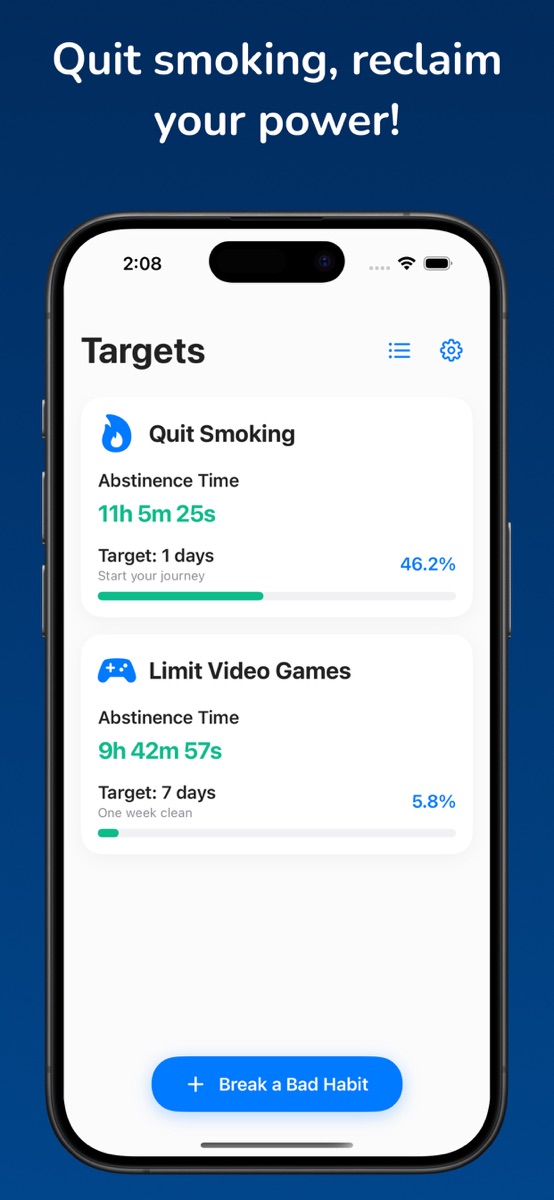
If you decide to quit, QuitBit can track smoke-free time, estimated savings and personal milestones on iPhone and iPad. It is a progress tracker, not cessation treatment.
Free to download · Optional in-app purchases Already quit? Calculate savings since your quit date →How much does a pack-a-day habit cost?
At an example price of $10 for a pack of 20, smoking one pack a day costs $10 per day, $70 per week, $300 over 30 days and $3,650 over 365 days. Half a pack a day costs half those amounts. These are illustrative prices, not current retail prices.
Calculate your own cigarette costs and quit-date savings with your pack price, pack size and daily use. If you have already quit, enter your quit date to estimate spending avoided so far.

Use your own inputs
Write down the price you usually pay, how many cigarettes are in that pack and your average cigarettes per day before quitting. If your use varied, choose a reasonable average from a typical period and keep a note of that assumption.
The calculation is proportional. It does not require you to buy a whole pack every day. Someone who smoked ten cigarettes daily from a twenty-cigarette pack used about half a pack per day on average.
Use a single currency throughout. The examples below use an invented $10 pack price; they are not claims about current cigarette prices in any country.
Compare daily and longer-term costs
| Cigarettes per day | Per day | 30 days | 365 days |
|---|---|---|---|
| 5 | $2.50 | $75 | $912.50 |
| 10 | $5 | $150 | $1,825 |
| 20 | $10 | $300 | $3,650 |
For ten cigarettes per day: 10 ÷ 20 × $10 = $5 per day. Multiplying by 30 gives $150. A 30-day comparison is not an exact calendar-month bill, and 365 days is a non-leap-year assumption. The calculation also assumes the price and smoking pattern stay the same.
Estimate savings after your quit date
At a previous average cost of $5 per day, fourteen smoke-free days represent an estimated $70 of cigarette spending avoided. The same period represents 140 cigarettes not smoked under the ten-per-day baseline.
Use the free quit-smoking savings calculator to enter your own baseline and quit date. Its output is an estimate of avoided spending, not a bank statement. A difference between the estimate and your account balance does not mean the arithmetic is wrong: purchases happen in packs, and your other spending also changes.
Separate gross savings from money available
If you want a fuller personal budget comparison, record other relevant costs separately. For example, $70 in estimated cigarette spending avoided minus $15 in additional recorded costs leaves $55 in that simple comparison. This is an invented bookkeeping example, not a reason to avoid recommended cessation treatment.
You may also spend some of the avoided cost elsewhere. If you want money to build toward a goal, record what you actually set aside rather than assuming the gross estimate was automatically saved.
QuitBit can keep a savings counter and your smoke-free time visible. A separate savings goal can track real money allocated to a purchase or reserve. Those records answer related but different questions.
Keep the time estimate in perspective
The free calculator can also estimate time formerly spent on smoke breaks. If the input is five minutes per cigarette, ten cigarettes represent fifty minutes in a day. Some breaks overlap with other activities, so this number is a simple estimate of break time.
It is not a calculation of extra lifespan or a prediction about your health. Use the milestone guide for personal checkpoints, and use a healthcare professional or quitline for help with quitting itself. The counter is there to show one part of your progress.
Common questions
Are these current cigarette prices?
No. The examples use an invented $10 pack price. Enter the price and pack size you actually use for a personal estimate.
Is money avoided the same as money in my savings account?
No. It estimates cigarette spending you did not incur. Your actual saved balance depends on what you set aside and any other spending.
References and further reading
Published by Moocsoft, the independent studio behind QuitBit. Examples and worksheets are illustrative. App features can vary by platform and version; see the store listing for current availability and in-app purchases.