Find what repeats across the complete rows, state the rule in words, and substitute every number back into it. A rule that fits only one row is not enough.

How to use these practice puzzles
Use a note, work mentally or print the question sheet. There is no time limit on this page, and each browser answer stays hidden until you open it. The examples below were written for this guide; they are not a list of solutions to numbered levels in the app.
If you enjoy this kind of reasoning, Moocsoft’s Math Riddles / Math Puzzles app offers a separate puzzle journey with hints and solutions. First try the free examples here to see whether the style suits you.
For a row puzzle, keep the direction consistent: use the first two entries to explain the third. For a conventional equation, use normal arithmetic rather than inventing a new meaning for the equals sign.
Get the free printable question sheet and answer key
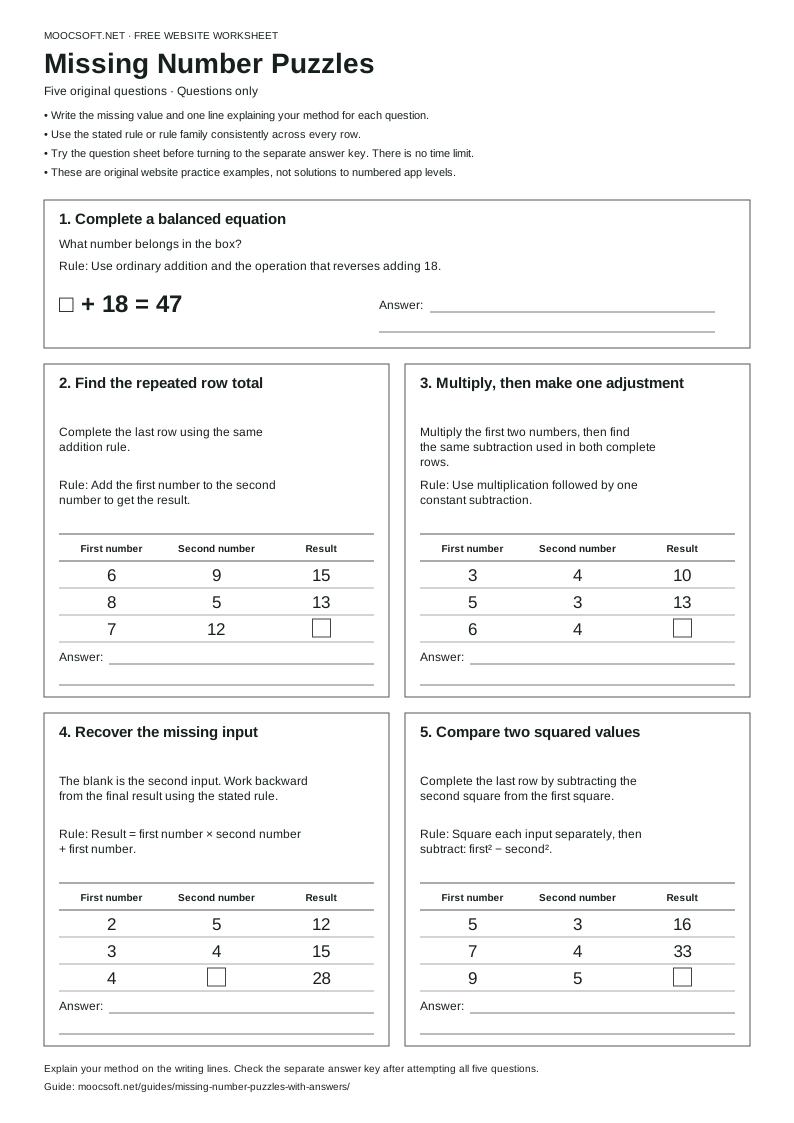
Open the printable missing-number worksheet for the same five questions with room to write your answers and reasoning. The questions and worked answer key are in separate sections so you can print the questions first and check afterward.
You can also download the question-only SVG sheet to print or save. Use the HTML worksheet for the separate answer key, or read every worked answer below. Both website outputs are free and require no app install or account.
The website practice and print files are separate from the app’s puzzle collection. App availability, ads and optional in-app purchases follow the current store listing; the free worksheet does not change what is included in the app.
Puzzle 1: complete a balanced equation
□ + 18 = 47
What number belongs in the box?
Reveal answer and check
29. Subtract 18 from both sides: 47 − 18 = 29. Substitute 29 into the original equation to check your answer.
29 + 18 = 47.
Puzzle 2: find the repeated row total
| First number | Second number | Result |
|---|---|---|
| 6 | 9 | 15 |
| 8 | 5 | 13 |
| 7 | 12 | □ |
Complete the last row using the same addition rule.
Reveal answer and check
19. The first two numbers add to the result in every row. Apply the same rule to the final row: 7 + 12 = 19.
6 + 9 = 15. 8 + 5 = 13. 7 + 12 = 19.
Puzzle 3: multiply, then make one adjustment
| First number | Second number | Result |
|---|---|---|
| 3 | 4 | 10 |
| 5 | 3 | 13 |
| 6 | 4 | □ |
Multiply the first two numbers, then find the same subtraction used in both complete rows.
Reveal answer and check
22. Each result is the product of the first two numbers minus 2. The final row is (6 × 4) − 2 = 22. Subtract after multiplying; subtracting 2 from an input would change the grouping.
(3 × 4) − 2 = 10. (5 × 3) − 2 = 13. (6 × 4) − 2 = 22.
Puzzle 4: recover the missing input
| First number | Second number | Result |
|---|---|---|
| 2 | 5 | 12 |
| 3 | 4 | 15 |
| 4 | □ | 28 |
The blank is the second input. Work backward from the final result using the stated rule.
Reveal answer and check
6. The final row means 4 × □ + 4 = 28. Subtract 4 to get 4 × □ = 24, then divide by 4 to get 6. Put 6 back into the original rule to check it.
2 × 5 + 2 = 12. 3 × 4 + 3 = 15. 4 × 6 + 4 = 28.
Puzzle 5: compare two squared values
| First number | Second number | Result |
|---|---|---|
| 5 | 3 | 16 |
| 7 | 4 | 33 |
| 9 | 5 | □ |
Complete the last row by subtracting the second square from the first square.
Reveal answer and check
56. Square both inputs separately. In the final row, 9² − 5² = 81 − 25 = 56. Squaring the difference would be a different operation: (9 − 5)² = 16.
5² − 3² = 25 − 9 = 16. 7² − 4² = 49 − 16 = 33. 9² − 5² = 81 − 25 = 56.
Choose the next kind of puzzle
If the arithmetic was easy but choosing a rule was difficult, try the hidden-rule strategy guide. If the layout is a list rather than a grid, use the number-pattern walkthrough. If brackets caused mistakes, work through the order-of-operations puzzles.
For new questions on your phone, download the app using the store buttons above. Make an attempt before using a hint, then compare the explanation with your own reasoning. These row examples specify their rule family because a small set of numbers can otherwise support more than one constructed rule.
Common questions
Can I print the puzzles without the answers?
Yes. The free HTML worksheet separates the question sheet from the answer key, and the downloadable SVG contains questions only. Both are website practice files that require no app installation.
Are these answers for specific Math Riddles app levels?
No. These are original practice examples for the website, not a walkthrough of numbered app levels.
Can a missing-number grid have more than one answer?
Without constraints, a small grid may fit multiple rules. These exercises give a rule or rule family to make the intended task clear.
How should I check a missing input?
Put your answer back into the original equation or row rule and calculate the result again.
Published by Moocsoft, the independent studio behind Math Riddles. Examples and worksheets are illustrative. App features can vary by platform and version; see the store listing for current availability and in-app purchases.