For positive fractions, compare numerators when denominators match, use a shared benchmark when possible, and compare cross-products when neither shortcut is convenient.
Start by asking what is already the same
A fraction describes a number of equal parts of a whole. These comparisons assume the same-sized whole and positive denominators. Five eighths of a small pizza is not necessarily more food than seven twelfths of a much larger pizza; here we compare the fractions themselves.
When denominators match, each piece has the same size. Therefore 5/9 is greater than 2/9 because five ninths contains more of those pieces. When positive numerators match, the fraction with the smaller denominator is larger: 3/5 is greater than 3/8 because fifths are larger pieces than eighths.
Try the original website exercises first. For a separate collection of number challenges on your phone, explore Moocsoft’s Math Riddles / Math Puzzles app. These are not solutions to specific app levels.
Use one half as a quick benchmark
To compare a positive fraction with 1/2, double its numerator and compare that with its denominator. For 5/12, doubling 5 gives 10, which is below 12, so 5/12 is below one half. For 7/12, doubling 7 gives 14, so that fraction is above one half.
This immediately separates 4/9 and 5/8: the first is below one half and the second is above it. It does not finish every problem. If both fractions are above one half, you still need to compare how far above they are.
Make the pieces the same size
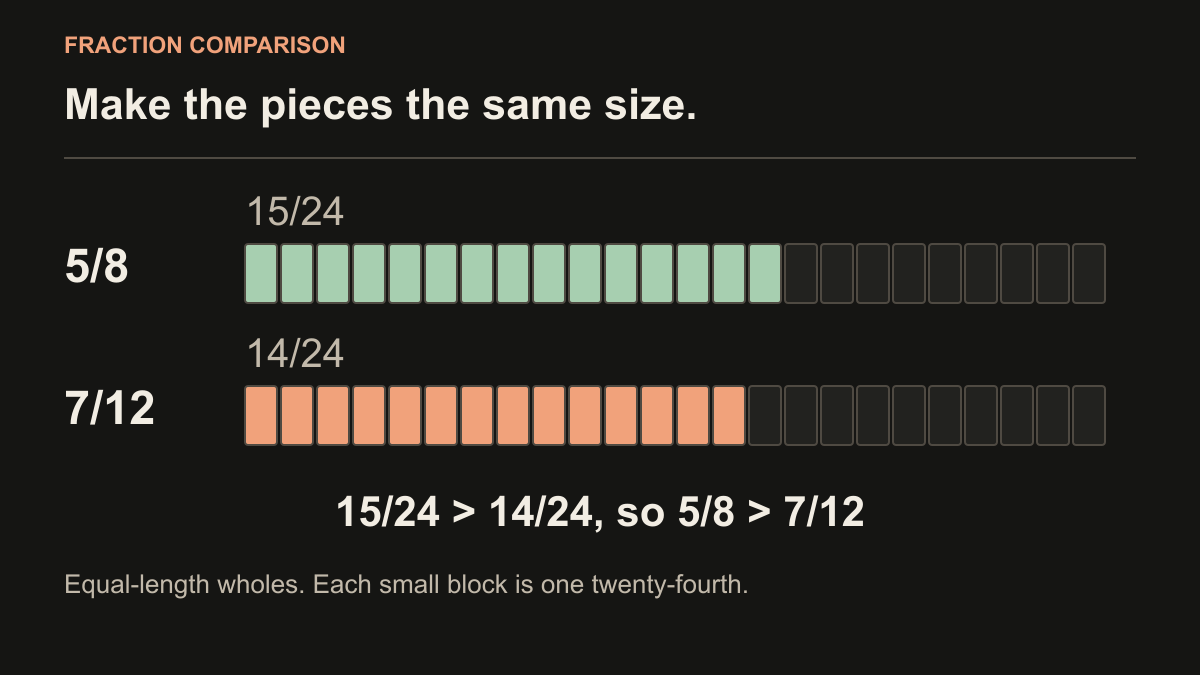
For 5/8 and 7/12, use 24 as a common denominator. Multiply the numerator and denominator of 5/8 by 3 to get 15/24. Multiply both parts of 7/12 by 2 to get 14/24. Now the comparison is direct: 5/8 is larger.
Multiplying both parts by the same nonzero number preserves the fraction’s value. Changing just the denominator does not. You also do not need the smallest common denominator to get a correct answer, although smaller numbers usually make the work easier.
Use cross-products as a general check
For positive denominators, compare a/b and c/d by comparing a × d with c × b. Both fractions could be rewritten with denominator b × d, so these products are their numerators on the same scale.
For 7/10 and 2/3, calculate 7 × 3 = 21 and 2 × 10 = 20. Since 21 is larger, 7/10 is larger than 2/3. If the products match, the fractions are equivalent.
Keep the direction straight: the numerator from the first fraction starts the first product. If multiplication is slowing you down, review the mental multiplication shortcuts before adding a timer.
Try six fraction comparisons
| Question | Pair | Useful starting point |
|---|---|---|
| 1 | 5/9 or 2/9 | Same denominator |
| 2 | 3/5 or 3/8 | Same numerator |
| 3 | 4/9 or 5/8 | Compare with one half |
| 4 | 5/8 or 7/12 | Common denominator |
| 5 | 7/10 or 2/3 | Cross-products |
| 6 | 6/8 or 9/12 | Simplify or cross-multiply |
Reveal all six answers
1: 5/9. Five ninths exceeds two ninths. 2: 3/5. Three fifths exceeds three eighths. 3: 5/8. It is above one half while 4/9 is below. 4: 5/8. Compare 15/24 with 14/24. 5: 7/10. Compare cross-products 21 and 20. 6: equal. Both simplify to 3/4; the cross-products are also equal at 72.
Check the method before trying a faster round
Repeat any missed comparison using a different method. For example, confirm the final pair by simplifying each fraction and then checking the cross-products. Matching results from two clear methods are more useful than repeatedly guessing.
Next, make your own pair by changing one numerator. Write the answer and a short explanation before challenging someone else. In the app, choose a challenge that is available in your version and keep accuracy ahead of speed; store listings explain which extra modes require Premium.
For another style of reasoning, try missing-number puzzles. For a repeatable mixed session, use the adult mental-math routine.
Common questions
Is a larger denominator always a smaller fraction?
Only when comparing positive fractions with the same positive numerator. If both parts change, compare the values using a benchmark, common denominator or cross-products.
Do I need decimals to compare fractions?
No. Common denominators and cross-products give exact comparisons without rounding decimals.
What does it mean if the cross-products match?
With nonzero positive denominators, matching cross-products mean the fractions have equal value.
Published by Moocsoft, the independent studio behind Math Riddles. Examples and worksheets are illustrative. App features can vary by platform and version; see the store listing for current availability and in-app purchases.